
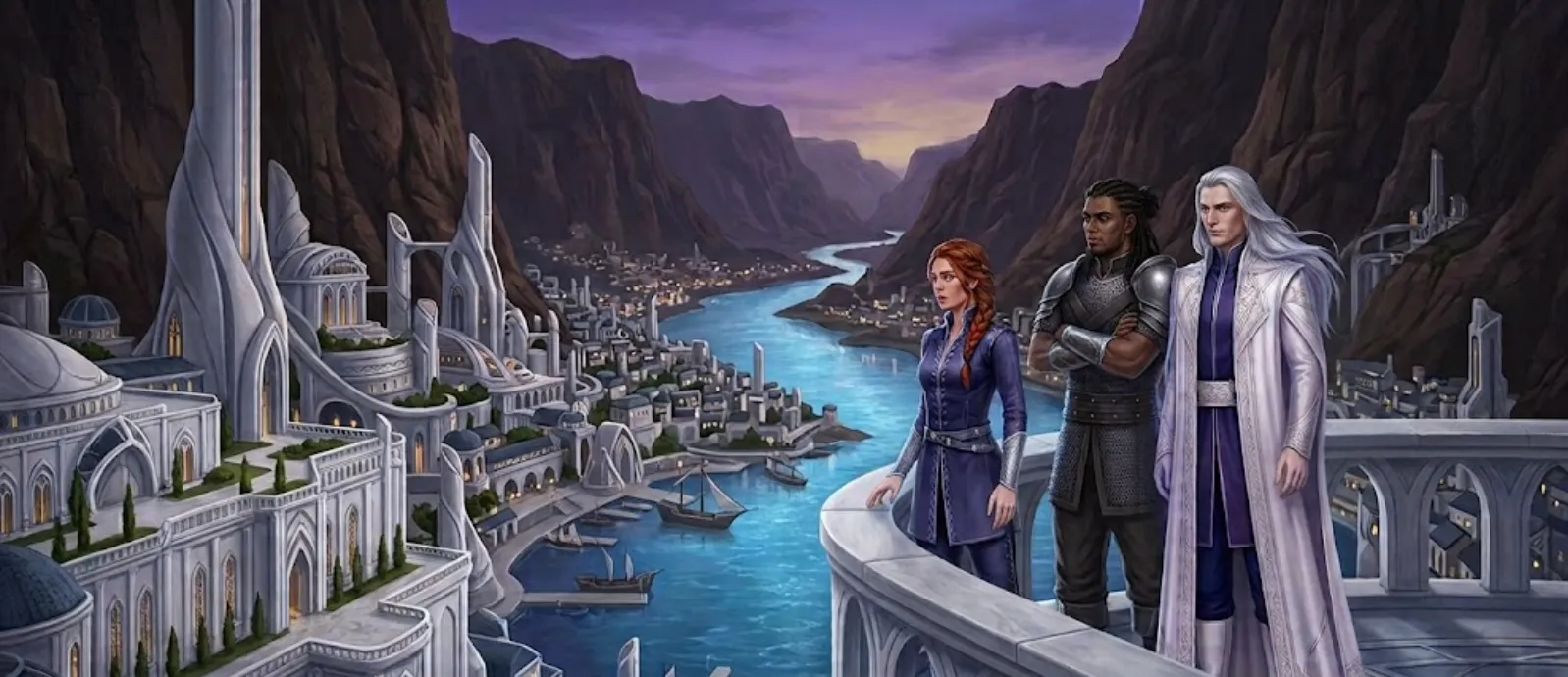
The Augurs occupy a strange position in the world of the Licanius Trilogy. By the time the story begins, they are gone — massacred in a single night roughly twenty years before the events of the first book. What remains is a story: that they were arrogant, that their visions failed them, that they tried to cover it up, and that a righteous rebellion finally brought them down. Duke Elocien Andras is celebrated for leading it. The Tenets — the system that now polices every Gifted person in Andarra — exist as its legacy.
Almost none of that story is true.
Gifted vs. Augur: the essential distinction
The Licanius Trilogy uses two terms that are easy to conflate: the Gifted and the Augurs. They are not the same thing, and the difference between them is the foundation of everything else in this article.
The Gifted manipulate Essence — the natural life force produced by their own bodies. Essence is purely physical energy: it can push, pull, heal, or destroy physical objects. A Gifted person draws from an internal Reserve of this energy. They are relatively common, which is why the Tenet system was designed to police them at scale.
The Augurs manipulate kan — a dark energy drawn from outside the world entirely, sourced from the Darklands. Kan is not physical. It cannot lift a rock or heal a wound. Instead, it interacts with non-physical elements: time, the mind, the future. There are always exactly thirteen of them alive at once.
There is one further distinction that the trilogy reveals gradually: unlike the Gifted, Augurs do not have an internal Essence Reserve. While they still naturally produce enough life force to keep themselves alive, they do not produce any excess energy to draw from. As Erran explains it: the Augurs can use Essence to power devices, but they must get it from external sources. Davian is a completely unique exception: because he actually died as a baby, his body lost the ability to produce any Essence at all. To survive, his Augur instincts unconsciously use kan to siphon trace amounts of life force from the environment just to keep his heart beating.
Where Augurs come from: Alchesh and the Forge
The Augur lineage traces back approximately two thousand years to a single individual: Alchesh Mel’tac, the first mortal Augur. Alchesh had a unique and anomalous connection to the Forge — the ancient Builder-made device that the Venerate are also bound to — possessing not one but thirteen distinct connections to its power.
When Alchesh died, those thirteen connections did not disappear. They detached and attached themselves to thirteen new individuals across Andarra. This established the cycle that defines the Augur lineage for the rest of the trilogy’s history: there are always exactly thirteen people in the world with the potential to manipulate kan, and when one dies, a new Augur is born somewhere to inherit that connection. The number is fixed. The individuals change. The lineage is self-perpetuating.
Alchesh himself helped Caeden and Andrael raise the Boundary to seal off Talan Gol — one of the foundational acts of the world the trilogy’s characters inhabit. He was eventually driven mad after a sha’teth infected his mind, giving him terrifying and involuntary glimpses of the Darklands. Despite his madness, his writings prophesied the events of the trilogy with precision, specifically foretelling that Davian would be the one to stop Aarkein Devaed. He saw the end of a story he would not live to witness.
How Augur powers actually work
Augur abilities — reading minds, seeing the future, manipulating time — are all expressions of kan. Because kan interacts with non-physical elements, it can do things Essence cannot: reach into thoughts, bend temporal perception, access what has not yet happened.
The future that Augurs see is immutable. This is the detail that sits at the center of the trilogy’s entire philosophical argument. The visions are not warnings of what might happen — they are glimpses of what will happen, on a single fixed timeline where every choice has already been made. This is precisely the framework Shammaeloth used to construct his deception: the Venerate were told that this determinism was a prison of Shammaeloth’s design, trapping humanity in inevitability. The Augurs’ ability to see that fixed future was, in the deception’s framing, a form of evidence for the prison’s existence.
Individual Augurs tend to have particular strengths within the broader range of kan-based abilities. Fessi could slow and step outside time. Erran excelled at Reading minds and forging mental links. Davian could unfailingly sense when someone was lying. Ishelle, once she had touched someone, could track their physical location for the rest of her life. The powers share a common source but express differently across individuals.
Their role in the Boundary
A common misconception, easy to arrive at from the surface-level logic of the story, is that the Augurs sustained the Boundary. They did not. The Boundary was powered for millennia by members of the Venerate — specifically Meldier and Isiliar — who were locked inside ancient devices called Tributaries, which drained their immortal Essence to fuel the barrier. The Boundary ran on the suffering of imprisoned immortals, not on the Augurs’ power.
What the Augurs could do — and what made them uniquely irreplaceable in relation to the Boundary — was manipulate its mechanisms. Because the Boundary is built around kan, the Augurs are the only beings capable of properly interacting with it to fix or seal it when it begins to fail. Alchesh helped raise it. The present-day generation of Augurs travels north to repair it. Their role is not to power the Boundary but to be the only ones who can work on it.
What Andarra believes — and what actually happened
The official history of the Augurs, as understood by the average Andarran citizen, is a story of deserved downfall. The Augurs were tyrants. Their visions stopped coming true. Rather than admit failure, they covered it up and used their control over the Gifted to violently suppress anyone who questioned them. Duke Elocien Andras led a righteous rebellion, the Augurs were overthrown and killed, and the Tenets were established to ensure nothing like them could rise again.
The actual sequence of events was orchestrated from the outside, by a single man acting on manufactured certainty.
Jakarris si’Irthidian was a leading Augur who had grown genuinely alarmed about the Boundary’s deteriorating state. His research led him toward the conclusion that the Augurs’ own unchecked use of kan was destabilizing the Tributaries and accelerating the Boundary’s decay. Before he could find conclusive proof, his quarters were infiltrated and his life’s work was destroyed. He suspected his own peers had sabotaged him to protect their power — though he could not prove it.
Isolated and desperate, he was found by Nethgalla, who confirmed his worst fears and convinced him that the only way to prevent global catastrophe was to remove the current generation of Augurs entirely. Believing he was acting for the greater good, Jakarris allied with Nethgalla and Duke Elocien Andras, orchestrated the rebellion — and personally murdered the other twelve Augurs in a single night.
Jakarris subsequently transformed himself into a Shadow and took the alias Scyner, hiding from the very Tenet system he had helped create. He spent years leading the rebel Shadows at the Sanctuary as the Shadraehin’s lieutenant — until he was killed by Erran near the end of the trilogy. When cornered by the enemy, Scyner attempted one final betrayal, trying to murder Erran so he could safely surrender and secretly save himself. Erran killed him in self-defense.
The Tenets: purpose or corruption?
The Tenets are the system that defines the lives of every Gifted person in Andarra by the time the trilogy begins: a set of enforced rules that bind them legally and physically, preventing them from challenging or harming non-Gifted people under any circumstances. They are presented to the public as a necessary safeguard against Gifted tyranny.
They have nothing to do with the Augurs’ genuine purpose. The Tenets were created using a Darecian Vessel provided by Nethgalla during the rebellion — a device designed specifically to permanently enslave and police the surviving Gifted population. They are not a reformed version of how the Augurs operated. They are a tool of control, built by the rebellion that destroyed the Augurs, handed to the winning side by the same entity who manipulated Jakarris into pulling the trigger.
Wirr’s arc across the trilogy is built almost entirely around what it means to hold that authority — the Oathstone that controls the Tenets — and what it costs to use it.
The Augurs: ancient era, pre-war, and present day
The Augur lineage spans thousands of years. The trilogy gives us meaningful detail on three distinct generations.
The first mortal Augur, and the origin point of the entire lineage. Alchesh’s anomalous thirteen-fold connection to the Forge established the cycle of thirteen Augurs that persists for the next two thousand years. He helped Caeden and Andrael raise the Boundary to seal Talan Gol. He was eventually driven mad by a sha’teth’s attempt to possess his mind, which gave him involuntary and terrifying glimpses into the Darklands. His madness did not prevent him from seeing clearly: his written prophecies accurately foretold Davian’s role in stopping Aarkein Devaed, though Alchesh died millennia before Davian was born.
The man who ended the Augurs. Jakarris was a leading member of the pre-war generation, increasingly alarmed by the Boundary’s deterioration and convinced — through a combination of genuine research and Nethgalla’s manipulation — that his fellow Augurs were the cause. He murdered all twelve of his peers in a single night, believing he was preventing the end of the world. He then hid from the Tenet system he had helped create by transforming himself into a Shadow and taking the alias Scyner, operating for years as the Shadraehin’s lieutenant among the rebel Shadows in the Sanctuary. He killed the young Augurs Kol and Rohin before being killed by Erran near the end of the trilogy. When cornered by the enemy, Scyner attempted one final betrayal, trying to murder Erran so he could safely surrender and secretly save himself. Erran killed him in self-defense.
Two leaders among the pre-war Augurs, briefly mentioned in Elocien Andras’s secret notebook as having verified his memories before the rebellion. They were among the twelve Augurs Jakarris murdered on the night the institution ended. The trilogy does not give them further detail — they exist primarily to confirm that the old generation was real and that the night of the massacre was methodical.
Because the old Augurs were wiped out in a single night, a new generation was born almost simultaneously — twelve connections to the Forge detaching and reattaching to new individuals at once.
Primary protagonist. Sixteen years old at the start of the trilogy.
Davian grew up at Caladel as an apparent Gifted student who could not access his Essence — which, given the mechanics of Augur physiology, makes sense: he had no Essence Reserve to access. His primary natural Augur talent is the ability to unfailingly sense when someone is lying. Over the course of the trilogy he learns to manipulate time, read minds, and shape-shift, eventually playing the central role in restoring the Boundary and defeating the Venerate. His arc ends with Caeden taking his place in the past so that Davian can survive — left alive in the broken world to do the hard work of rebuilding it.
One of the most powerful Augurs of the present generation, kept hidden in the palace by Erran and Duke Elocien Andras. Fessi’s primary talent is the ability to slow and step outside of time entirely — one of the most rare and significant Augur abilities in the trilogy. She travels north to fix the Boundary but becomes trapped in Talan Gol. She and Davian are captured by the Blind and taken to the Venerate’s city, Ilshan Gathdel Teth. Recognizing a notoriously dangerous section of the city called Seclusion from a vision, a panicked Fessi flees inside and is brutally mauled to death. Her corpse is later discovered by Davian being used as a physical proxy by the Venerate member Gassandrid — one of the more disturbing images in the trilogy.
Exceptionally skilled at Reading minds and establishing mental communication links. After being discovered by Administration, Erran was forced to serve Duke Elocien Andras — and responded by secretly using his powers to Control the Duke for years, bending Elocien’s hatred of the Gifted just enough to keep Fessi, Kol, and the others safe. It is a morally complicated act, quietly sustained across years, that the trilogy treats with the ambiguity it deserves. Erran is captured by the Gil’shar during the final invasion and hanged by his captors.
Mentored in secret by Elder Driscin Throll at Tol Shen. Ishelle’s unique talent is precise and permanent: if she touches someone once, she can track their physical location for the rest of their life. She initially uses this to find Davian and attempt to recruit him to Tol Shen. Later, trapped in Talan Gol alongside Davian and Fessi, she forms a dangerous mental connection with the eletai — the hive-mind Banes — an experience that shapes much of her arc in the north. During the final battle, she makes the ultimate sacrifice, fully giving herself over to her mental connection to the eletai to compel the swarm to turn on the dar’gaithin, saving the Andarran army at the cost of her own life.
A rogue Augur sent to Tol Shen by Scyner. Rohin’s ability is a specialized and deeply unsettling form of Control: whatever he speaks aloud, people are compelled to believe as absolute truth. He uses this to briefly enslave the entirety of Tol Shen before Davian — whose lie-detection ability directly counters Rohin’s power — and Erran subdue him by melting an Augur-disabling amulet around his neck. Helpless and imprisoned, he is later assassinated by Scyner, who kills him simply to retrieve the amulet.
A gentle giant — massive and physically imposing, quietly protective of the people around him. Kol lived in secret at the palace alongside Erran and Fessi. When Scyner infiltrated their Lockroom, Kol attacked him to protect the others and was stabbed to death. The trilogy does not give him extensive page time, but his death is the kind that lands: a person defined entirely by his care for others, killed in an act of it.
Malshash is not a separate Augur. He is Tal’kamar — Caeden — living under an alias nearly a century in the past in Deilannis. Because Tal’kamar has already lived for millennia and understands what Davian will need to survive, he orchestrates this encounter deliberately: teaching Davian how to master kan, Reading, and time manipulation (though Davian secretly had to teach himself shape-shifting against Malshash’s explicit orders). He appears here because readers encountering “Malshash” in the text often do not immediately connect him to Caeden. He is the same person.
The present-day generation also includes several minor members who never had the chance to develop their abilities: a young female Augur killed by an angry mob in the town of Variden before she could be reached, and four children — one as young as eight years old — whom Duke Elocien Andras hunted down and murdered before Erran took Control of his mind to stop the bloodshed. They are not given names. Their deaths are the clearest illustration of what the post-rebellion world thought of Augurs.
The Augurs were not what Andarra remembers them as. They were a lineage of thirteen, always exactly thirteen, connected to a Builder-era device through a chain that stretches back two thousand years to a single man who went mad seeing too much. Their powers were real, their role in the Boundary’s construction was real, and their destruction was engineered by an outsider who used one of their own to finish the job. What replaced them — the Tenets, the rebellion’s legacy — was not justice. It was a control system, built by the winning side, handed to them by an entity with no interest in anyone’s freedom. The present-day generation of Augurs spent the trilogy trying to fix a world that had spent twenty years erasing them.