
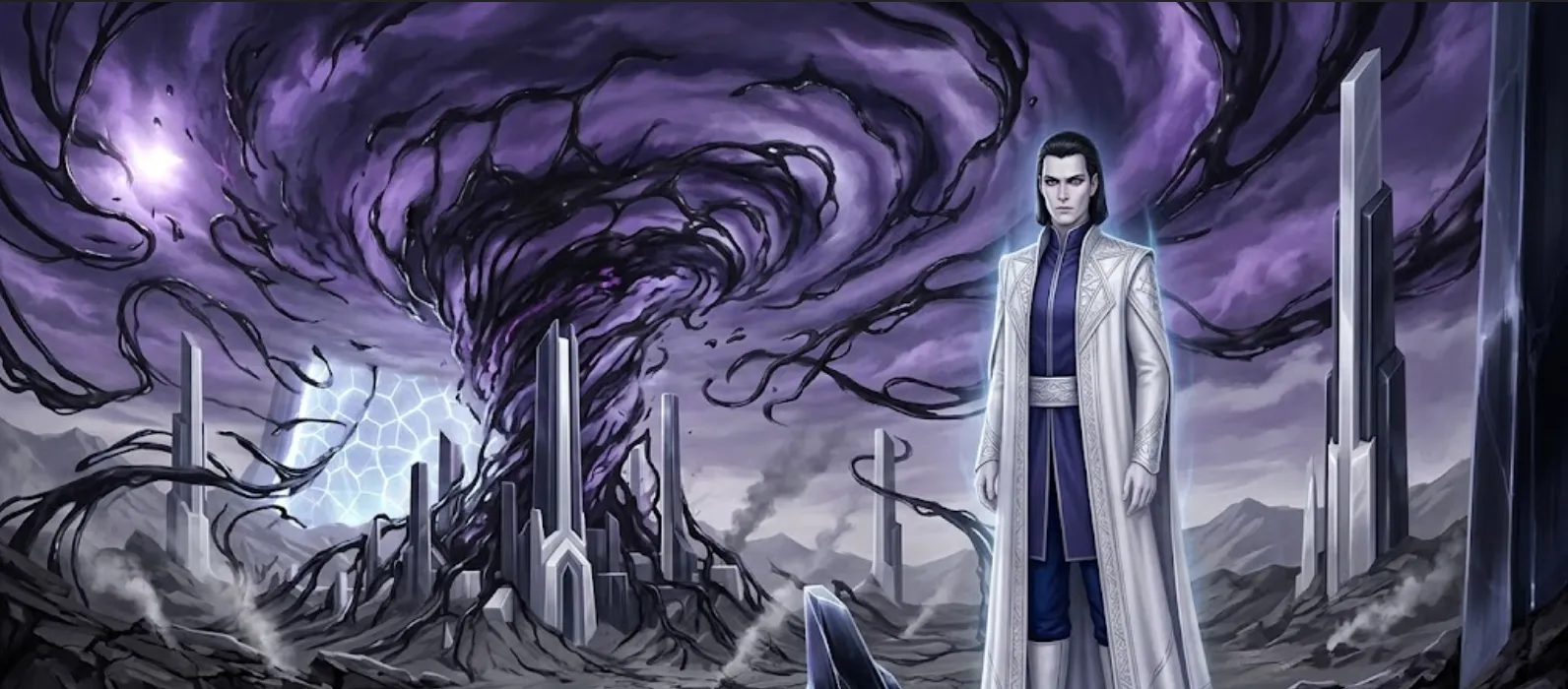
The Venerate are the Licanius Trilogy’s most powerful faction and its most tragic one. Eleven immortal beings, bound to the world by an ancient Builder-made device called the Forge, who spent millennia committing atrocities they believed were necessary to free humanity from the prison of fate. They were wrong. The entity they served as El was Shammaeloth himself. Every sacrifice they made — every city burned, every life taken — served his escape plan, not their liberation.
There are eleven members in total. The books give some of them full arcs and standout scenes. Others are little more than names attached to a fate. Both are worth knowing.
Before Shammaeloth: what the Venerate actually were
The most important thing to understand about the Venerate is that their immortality had nothing to do with Shammaeloth. They were already immortal when he found them. Their connection to the Forge — the Aloia Elanai, a device of Builder-era construction — predated his involvement entirely. When a member of the Venerate died, the Forge pulled them back from the Darklands and forced resurrection. They could not permanently die by ordinary means.
Shammaeloth did not give them this. He found a group of people who already couldn’t die, explained their immortality to them as a divine gift from El, handed them a cosmological purpose, and taught them how to draw kan. The deception was patient and precise. He used a pre-existing religion — the Old Religion and its creation myth — as his costume, knowing that a lie built on true foundations holds longer than one built from nothing.
The result was eleven immortals who believed they were El’s chosen instruments against a god of determinism. They were instruments, but not for El.
Members of the Venerate
“We are the blade, Meldier. Just the blade.”
The protagonist of the trilogy, and Shammaeloth’s greatest weapon. Tal’kamar was the strongest of the Venerate — Shammaeloth told him so directly, identifying him as the one who leads the way, the only member with the capacity to carry out the plan’s worst requirements. That capacity was the point. Shammaeloth needed someone capable of leveling Dareci, home to millions, to force the survivors to build the Jha’vett. Tal’kamar was the blade he sharpened for that purpose.
The name Aarkein Devaed belongs to that version of him — the one who destroyed Dareci, who the present-day world knows as the architect of the Plains of Decay. Caeden is what he became after erasing his own memories to wield Licanius, the only sword that could kill a Venerate permanently. He spent the trilogy recovering those memories and reckoning with what they contained.
His ending is the trilogy’s final, massive twist. Rather than allow Davian to travel back in time to die as the timeline seemed to require, Caeden forces a protective torc onto Davian and uses an ancient amulet to permanently strip his friend of his Augur powers. The agonizing process knocks Davian unconscious and disintegrates the amulet, ensuring Davian is left alive and unable to follow. Caeden then takes his place. He travels back to Deilannis, shape-shifts into Davian using kan, and confronts his past self — Tal’kamar. He delivers the truths his past self needs to hear, deliberately goading him into drawing Licanius and beheading him. Caeden accepts his death at the hands of the monster he used to be. The distinction, by the end, is the point.
“In short, Tal’kamar, we are puppets. We live in a prison of inevitability. A mirage of choice.”
The founder of the Venerate. In his early life, Gassandrid was a leader in the desert city of Kharshan — one of the few pre-Venerate biographical details the trilogy provides for any member. He was Shammaeloth’s primary evangelist: the one who gathered the other immortals together and delivered the deception to them. He approached Tal’kamar and the others with visions of the future, painting the picture of a world enslaved by determinism and offering them a divine mandate to fight it.
The irony is contained in his own words. He described humanity as puppets living in a prison of inevitability — and spent millennia being exactly that, serving a god he believed he was fighting. He never broke from the deception. He remained fiercely loyal until Caeden and the others attacked Deilannis to seal the rift, where he was killed.
“I am tired of living in a world where I can never be in control of my own actions.”
Arguably Tal’kamar’s closest friend among the Venerate, and one of the members the trilogy gives the most biographical grounding. Alaris was the immortal king of the Shining Lands before his involvement with the group — a detail that makes his arc quietly devastating. He was a ruler who believed in agency, in the power of individuals to shape their own destinies, and he joined the Venerate because Shammaeloth’s offer gave that belief a cosmic scale.
He stayed loyal not out of fanaticism but out of a desperate need for the sacrifices to have been worth it. The atrocities he participated in were too large to be meaningless. Abandoning the cause would mean accepting that they were. His own words — tired of a world where he could never control his own actions — describe exactly the trap he was in. He had less control than anyone.
Caeden showed Alaris the truth of Shammaeloth via transferred memories before killing him with Licanius in Mor Aruil. But the deception ran too deep; Alaris accused Caeden of fabricating the memories and died refusing to believe the truth.
The first member to see through Shammaeloth’s deception. Andrael was a master inventor and tactician who arrived at the truth through his own reasoning — concluding that the entity they served was not working to free humanity, but to widen the rift to the Darklands and escape the world entirely. He understood the endgame before anyone else did.
His response was methodical. He forged the five Named Swords — including Licanius — as the only weapons capable of permanently killing a member of the Venerate. He then struck a deal with the Lyth to guard Licanius, ensuring it would exist and be accessible when the time came to use it. He built the solution to a problem the others didn’t yet know existed.
He appeared as a young man to Tal’kamar in the burning ruins of Silence, gently but firmly revealing what he had done and why — handing Tal’kamar the thread that would eventually unravel everything. The other Venerate killed him for his betrayal before the main events of the trilogy. He did not live to see his weapons used. He built them anyway.
“He is very, very good at using truth to lend strength to his lies, and he has used the core of that religion to lie to us from the beginning.”
An Augur who eventually broke from the Venerate and spent a century in deliberate hiding at the Wells of Mor Aruil, waiting. His purpose in waiting was specific: to restore Caeden’s erased memories so that Caeden could stop the invasion. He understood exactly what was needed and committed to the long patience of making it happen.
He is also the character who most plainly articulates how Shammaeloth’s deception functioned — not through outright fabrication, but through the surgical use of truth as camouflage. His quote captures the mechanism better than any other line in the trilogy.
He was killed by Nethgalla, who had shape-shifted into the form of Caeden’s wife Elliavia, before he could finish restoring Caeden’s memories. He died doing the one thing he had spent a century positioning himself to do, stopped just short of completing it.
“Our every moment from birth has been guided, prepared, set up in such a way as to ensure a very particular outcome. And choice is meaningless if it cannot affect the outcome.”
The Venerate’s most ideologically committed member. Meldier was a true believer — not merely loyal to the cause, but philosophically consumed by it. His hatred of determinism was not abstract. He experienced the fixed nature of the timeline as a personal affront, a violence done to every conscious being that had ever lived. His argument — that choice is meaningless if it cannot affect the outcome — is the clearest articulation of what the Venerate believed they were fighting.
He is also the character who most directly embodies what that belief becomes when it is weaponized by a patient manipulator. Caeden originally imprisoned Meldier in a Tributary to help power the Boundary. After Caeden freed him in the Plains of Decay, Meldier tortured Caeden in Ilshan Gathdel Teth. He was killed there by Davian, who used Licanius to end him permanently.
Paranoid and vicious, Isiliar is one of the Venerate’s most dangerous members — and one whose end is shaped entirely by what was done to her. Caeden imprisoned her in a Tributary to power the Boundary, as he did with Meldier. Unlike Meldier, the imprisonment drove her completely insane.
When she broke free, she went on a violent rampage through Ilin Ilan. She was eventually killed in Ilshan Gathdel Teth during a fight with Caeden. A standout scene earlier in the trilogy shows her casually torturing the sha’teth Vhalire to extract information about Caeden, ranting about how a man who believes is the most dangerous enemy. The observation is accurate. It also describes her.
Notoriously cruel, and defined in the trilogy primarily by her targets and methods. Diara actively worked to undermine Asha and Davian, and reserved a particular visceral hatred for the Lyth — the beings Andrael had entrusted to guard Licanius. She kidnapped and tortured them as an experiment to determine whether taking them through the ilshara (the Boundary) would truly kill them. The detail is characteristic: her cruelty was methodical, not impulsive.
Her end is appropriately clinical. While her mind was trapped invading Asha’s dok’en, her physical body was left entirely defenseless and asleep in her own room in Ilshan Gathdel Teth. Caeden simply bypassed the room’s defenses, walked over to her bed, and quietly pushed Licanius through her heart.
The group’s primary researcher and the most mechanically obsessed of the Venerate. Cyr’s relationship to immortality was unique: he treated it as a laboratory. He killed himself roughly 200 times in a single year to study what happened — to glimpse the Forge and understand its mechanics. Most people would experience immortality as a comfort or a burden. Cyr experienced it as a dataset.
His inventions shaped the world of the trilogy in significant ways. He created the massive Essence-storing Cyrarium and the Furnace. He also exploited the Forge connection of a captured Shalis named Esdin to create the Dar’gaithin. He volunteered to be sealed in a Tributary in Nesk for a decade, viewing the isolation as a paradise for reflection and study.
He remained safely hidden in his Tributary in the south throughout the main events of the trilogy. He presumably died permanently when Caeden severed the world’s connection to kan at the rift — an end determined not by any confrontation, but by the closing of the system he had spent his existence studying.
A brilliant inventor who broke from the Venerate early. Wereth is notable for two things: what he built and what he regretted. He invented the Siphon — the device that Nethgalla later used to steal Essence from the Shadows — and he passed foundational kan theory to the Darecians so that they could fight back against the Venerate’s plans. Both were acts of defection. Both had consequences he could not control.
The Siphon, in particular, outlived his intentions and was used for purposes he never sanctioned. He died long before the main events of the trilogy, deeply regretting having ever created it. He is a minor figure in terms of page time, but his inventions cast a long shadow across the entire story.
The Licanius Trilogy tells us almost nothing about Tysis. She is one of the original eleven members of the Venerate, and her death is the only significant detail the books provide: she was killed by Andrael during the destruction of the city of Silence. That is the full extent of what we know. She existed, she was present, and she died early — at the hands of the first member to turn against the group’s purpose.
The pattern
What the Venerate add up to
Four of the eleven eventually turned against Shammaeloth’s plan: Tal’kamar, Andrael, Asar, and Wereth. The remaining seven — Gassandrid, Alaris, Meldier, Isiliar, Diara, Cyr, and Tysis — stayed loyal to the end, or at least until they were killed. The split is not random. The ones who defected are, broadly, the ones who either reasoned their way to the truth independently (Andrael, Wereth) or were eventually given access to it by someone who had (Asar, Tal’kamar). The ones who stayed loyal never had a reason they found sufficient to doubt what they had already decided to believe.
That is Shammaeloth’s real accomplishment. He did not need all eleven to remain loyal forever. He needed them loyal long enough. And the ones who did break — Andrael, killed immediately; Wereth, dead before the events of the story; Asar, stopped just short of completing his purpose — were neutralized before they could undo the damage. Only Tal’kamar was left to finish it. One out of eleven, carrying the weight of what the other ten either did or allowed.
The Venerate were not evil people seduced by evil. They were people with a genuine philosophical grievance — the apparent meaninglessness of choice in a deterministic universe — who were handed that grievance by the entity it most served to manipulate them. Shammaeloth did not recruit monsters. He made them. The members who stayed loyal were not weaker or less moral than those who broke. But the deception ran so deep that even when presented with the undeniable truth, they refused to believe it, choosing the comfort of their righteous lie over the horror of what they had actually done. In a trilogy obsessed with fate and free will, that distinction matters more than it might seem.