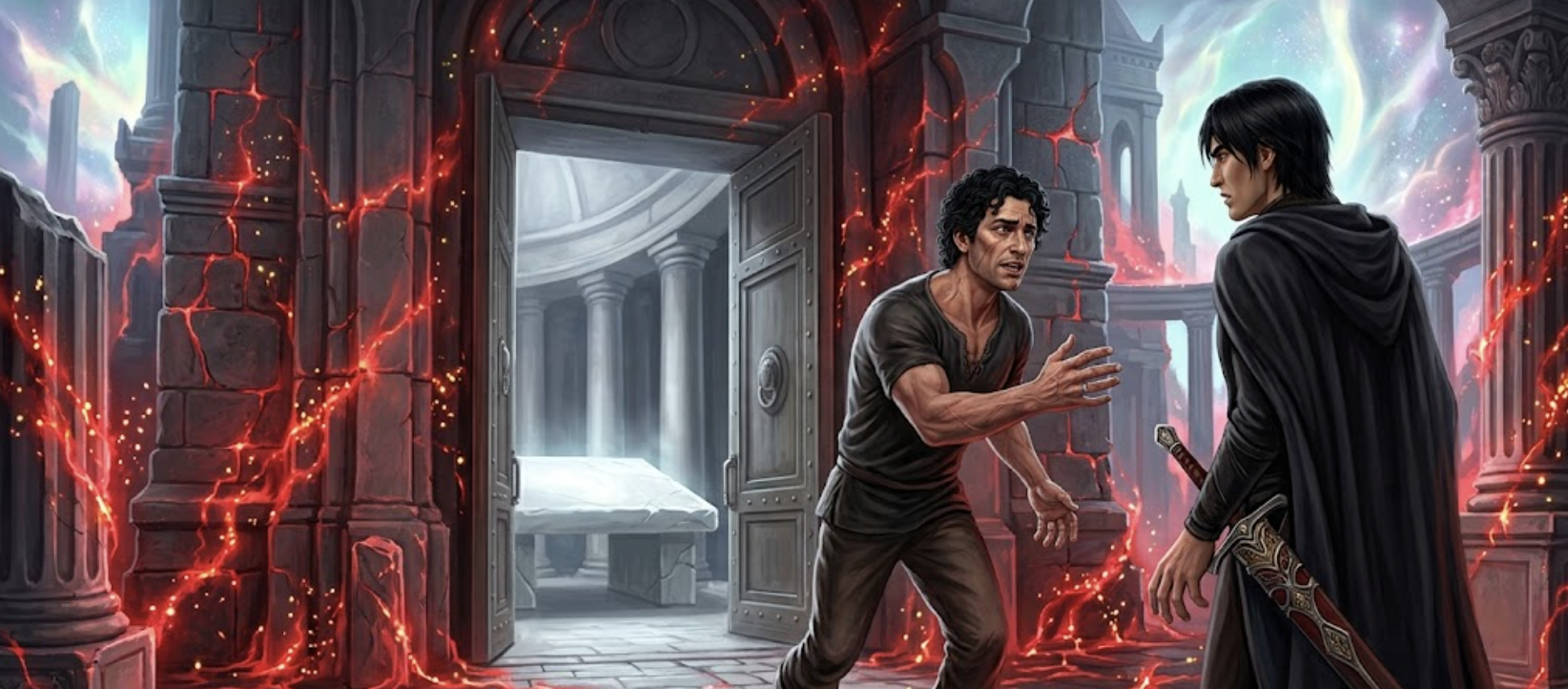
📖 Introduction & Why This Book Matters
What if the darkest, most terrifying evil in the world’s history was actually you?
An Echo of Things to Come by James Islington doesn’t settle for a standard good-versus-evil narrative. It goes somewhere far more uncomfortable — a labyrinthine, philosophical reckoning with inevitability and free will, asking readers to weigh the crushing burden of guilt against the fragile hope of redemption. At its core, the novel forces a question that doesn’t have a clean answer: can the “greater good” ever truly justify world-breaking acts of horror?
If you’ve made your way through Book 1, this is where Islington starts cashing in his chips. The puzzle-box clicks into place — slowly, sometimes frustratingly so — but the moral weight underneath it is real, and the questions it leaves you with are the kind that follow you off the page.
✍️ Plot Summary
In the aftermath of a devastating attack on the capital city of Ilin Ilan, the magical Boundary is failing. The ancient, apocalyptic force it was built to contain is stirring, and Andarra is running out of time. Four character arcs fracture across the realm — and slowly, inevitably, collapse into each other.
Davian and the Augurs at Tol Shen
Davian and his fellow Augur Ishelle travel to Tol Shen hoping to warn the Gifted leadership about the decaying Boundary — and find a Council too paralyzed by prejudice to listen. Things get worse fast: a newly arrived Augur named Rohin carries a terrifying ability called “Control,” making his spoken words function as absolute truth to anyone who hears them. He uses it to subjugate the Elders outright. Davian eventually forges an alliance with two pre-war Augurs in hiding, Erran and Fessi, Asha’s friends from Book 1. Together, they break into a kan-proof vault beneath the Tol Shen Archive, recover a golden amulet designed to neutralize Augur powers, and slip it onto Rohin’s neck — disabling his abilities in agonizing fashion. The four Augurs then flee north toward the Boundary, racing against a collapse none of them are sure they can stop.
Wirr’s Political Struggle
Wirr assumes his late father’s role as Northwarden and immediately discovers just how hostile the Administration is to everything he stands for. He survives an assassination attempt — thwarted by the rogue Augur Scyner — and then finds something more dangerous than a blade in his father’s hidden safe: a sealed journal. What it reveals is brutal. The Gifted, before the war, committed unchecked, horrific crimes against ordinary people — crimes that explain, if not justify, the deep-seated fear the population still carries. And then comes the worst of it: Elocien, Wirr’s own father, had been secretly Controlled by Erran for years before his death. The man Wirr mourned wasn’t entirely himself, and truly, his father had never come to accept or love Wirr because of his Gifted status. Wirr also discovers that possessing an Oathstone gives him the power to issue irresistible, Tenet-like commands to Administrators — absolute authority handed to him on a platter. He refuses to use it intentionally, but does come to realize, in hindsight, that he has accidentally leveraged these powers over his mother to secure agreement for his sister to leave their home and return with Wirr to the palace. Eventually, he brings his hostile mother Geladra and his political opponents directly to the Boundary, gambling that the proof of the northern threat will do what argument cannot and convince them finally of the emergency at the border.
Caeden’s Search for His Memories
Caeden, an immortal who wiped his own memory to escape his identity as the world-breaking tyrant Aarkein Devaed, spends the novel reliving what he buried. Working with the Venerate Asar Shenelac in the Wells of Mor Aruil, he recovers ancient memories of his atrocities — and learns that his former immortal allies were manipulated by a dark god named Shammaeloth. He also uncovers memories of his friend Andrael, who forged five Named Swords, including Licanius and Whisper, each capable of permanently killing the Venerate. Caeden travels to the ruined Darecian city of Deilannis, fights and kills the insane Venerate Isiliar, then presses on to Res Kartha to fulfill an ancient bargain: freeing the fiery beings known as the Lyth from their prison by binding their power to a magical Siphon.
Asha’s Investigation and Sacrifice
In Ilin Ilan, Asha secretly investigates the underground Sanctuary while experiencing unexplained dizzy spells she can’t account for. She joins an expedition to Deilannis alongside a Hunter named Breshada — who, deep in the ruins, reveals her true form as Nethgalla, the ancient shape-shifter who has been orchestrating events for decades. Nethgalla delivers the Siphon to Caeden, but her real move is on Asha: she tricks her into stabbing her with Whisper, the Essence-absorbing sword. The blade drains Nethgalla’s massive immortal Reserve and transfers it to Asha, curing her of being a Shadow in the process. Then Nethgalla explains what she’s done. Asha now holds exactly the amount of power needed to act as a human battery inside the Tributary — a horrific device of needles and Essence — and must sacrifice her own freedom to seal the Boundary.
How It All Comes Together
Wirr’s gamble partially works: the Administrators witness the Boundary’s failure firsthand. But the timing is catastrophic. The barrier collapses before anything can be done, and a massive army of dar’gaithin and flying eletai pours into Andarra. Geladra and many others are killed in the slaughter.
Nearby, Davian, Fessi, and Ishelle discover an anomaly in the kan mechanisms — a doorway straight through the Boundary. They cross into Talan Gol. The doorway vanishes behind them. Ishelle finds a suit of “Blind” armor (Telesthaesia) that shields her mind from the monsters and escapes back through the Boundary to warn the others. Davian and Fessi are left behind, trapped as the dark army closes in.
Asha, watching through a mental link with Erran, sees them run out of time. She steps into the Tributary and seals the Boundary.
The novel ends with Davian and Fessi marching across Talan Gol as prisoners of the Blind — arriving at a dark city where Davian uses Licanius to strike down the Venerate Meldier and attempts to free Caeden. Caeden refuses. He confesses his true identity as Aarkein Devaed, and tells Davian that he must behead him — so he can resurrect elsewhere and continue what needs to be finished. Davian obliges.
💡 Key Takeaways & Insights
1. The Subversion of the “Dark Lord” Trope
Islington pulls a stunning reversal on the genre’s oldest convention. In An Echo of Things to Come, the “Dark Lord” isn’t a faceless shadow looming on the horizon — he’s one of the story’s primary protagonists, and he’s horrified by who he used to be. Caeden’s decision to wipe his own memory out of disgust for his past atrocities creates a profound tension at the heart of the book: identity is not fixed, but the consequences of your actions don’t disappear just because you’ve forgotten them.
2. The Danger of the “Greater Good”
This novel is relentless in its critique of ends-justify-the-means thinking. Characters repeatedly commit unforgivable acts — genocide, mind-control, betrayal — convinced they’re serving a grander purpose. The moral decay that follows isn’t subtle. Islington wants you to feel it, and he makes sure you do, stacking the cost of every “necessary” atrocity until the weight becomes suffocating. By the end, the book’s argument is clear: "for the greater good" is almost always a story someone tells themselves in a futile attempt to alleviate the agony of their own moral suffering.
3. The Courage of Restraint in the Face of Absolute Power
While the novel heavily critiques those who commit atrocities for the "greater good," it actively champions the characters who choose moral restraint when handed ultimate authority. Wirr discovers he possesses an Oathstone that gives him the terrifying ability to issue irresistible, mind-controlling commands to his political enemies. Yet, despite intense pressure from his allies to force his rivals to vote for his policies, Wirr refuses, recognizing that a leader who enforces his will by stripping away free choice is no leader at all. Similarly, when Davian's allies suggest executing a captured, dangerous Augur simply because it is politically expedient, Davian furiously shuts them down. Through Wirr and Davian, the book argues that true morality isn't just about striving for the right outcome—it's about refusing to take corrupting shortcuts to get there.
🤯 The Most Interesting or Unexpected Part
The most shocking and unexpected twist comes when Caeden recovers a horrifying memory of murdering Davian. In this memory, set amidst the burning Darecian city of Deilannis, an older, time-traveling version of Davian emerges from the Jha'vett to confront Caeden. Davian warns his friend that the god El has been deceiving him, boldly accusing Caeden of slaughtering millions of innocents to serve his own selfishness. Furthermore, Davian insists that Caeden's wife, Elliavia, is truly dead and cannot be brought back. Enraged and unable to accept the agonizing truth of these accusations, Caeden draws his sword, Licanius, and brutally decapitates the time-traveling Davian, later mounting his severed head on a steel pike as a grisly warning to others. The most devastating dramatic irony of this twist is that Caeden only recovers this memory after they have parted ways in Talan Gol, meaning Davian currently remains completely unaware of his future death at his friend's hands.
🏛️ How This Book Applies to Real Life
- The Seduction of Extremism: The immortal Venerate aren't fighting for evil because they simply want to destroy the world; they were manipulated by the dark god Shammaeloth, who disguised himself as a deity of light and gave them a "compelling morality" to live by. Shammaeloth used their genuine desire to do good to trick them into committing atrocities for the "greater good." This reflects how real-world radicalization and extremism often work. Dangerous ideologies rarely present themselves as outwardly evil; instead, they prey on people's desire for meaning, belonging, and a righteous cause, twisting good intentions into horrific actions.
- Accountability vs. Avoidance: Caeden wiped his memories to escape the weight of what he’d done — the ultimate act of psychological avoidance. His journey is a slow, brutal confrontation with the truth that you cannot outrun what you are by forgetting it. Real redemption, the book argues, requires fully owning your sins rather than erasing or rationalizing them. Deliberate ignorance is cowardice.
Who should read An Echo of Things to Come?
- Fans of sprawling, multi-POV epic fantasy with intricate, earned magic systems — think The Stormlight Archive by Brandon Sanderson or The Wheel of Time by Robert Jordan
- Readers who love character-driven fantasy with complex time-travel mechanics
- Anyone who wants deep political maneuvering paired with high-stakes, morally gray conflict
You must read Book 1, The Shadow of What Was Lost, first. Otherwise, you will be very, very confused.
📚 Final Rating
3.8 / 5 Stars
The puzzle-box narrative and Caeden’s arc are genuinely brilliant, and the magic system remains one of the most rigorously constructed in the genre. But this is a slow, demanding book — and not always in a way that feels particularly entertaining. Most of the true plot momentum is crammed into the final 10% of the book. The payoff justifies the patience, but just barely, and I suspect many readers will not make it there.
Discussion Topics
Guilt & Identity
Caeden discovers that he is Aarkein Devaed — the ancient tyrant responsible for world-breaking atrocities — and that he chose to wipe his own memory to escape who he was.
- Is wiping your own memory to escape guilt a cowardly act of avoidance, or a necessary step toward genuine change?
- Does Caeden deserve redemption for his past actions, or are some acts too horrific to ever be forgiven?
- How much are we defined by past actions versus our current choices?
The Ethics of the “Greater Good”
Several characters — including the Augur Scyner (Jakarris) and Erran — commit terrible acts, such as murdering allies or secretly mind-controlling political leaders, because they believe it is necessary to save the world.
- Do the ends ever truly justify the means when the fate of the world is at stake?
- How does Erran’s secret control over Elocien parallel the very tyranny of the Gifted they were fighting against?
- At what point does fighting for the “greater good” turn a hero into a villain?
Reforming a Prejudiced System
Wirr inherits the role of Northwarden and attempts to reform the oppressive Tenets from within a deeply toxic political structure. His mother, Geladra, fiercely opposes him — pointing to the historical abuses the Gifted committed as justification for their continued oppression.
- How does the book handle the “oppressed mages” trope differently by giving the oppressors a historically valid reason for their fear?
- Was Geladra justified in her fears about the Augurs and the Gifted?
- Is it possible to peacefully reform a corrupt system from within, or does meaningful change require tearing it down entirely?
Discussion
Comments are moderated and will appear after review by the site owner.
No comments yet. Be the first to share your thoughts!