
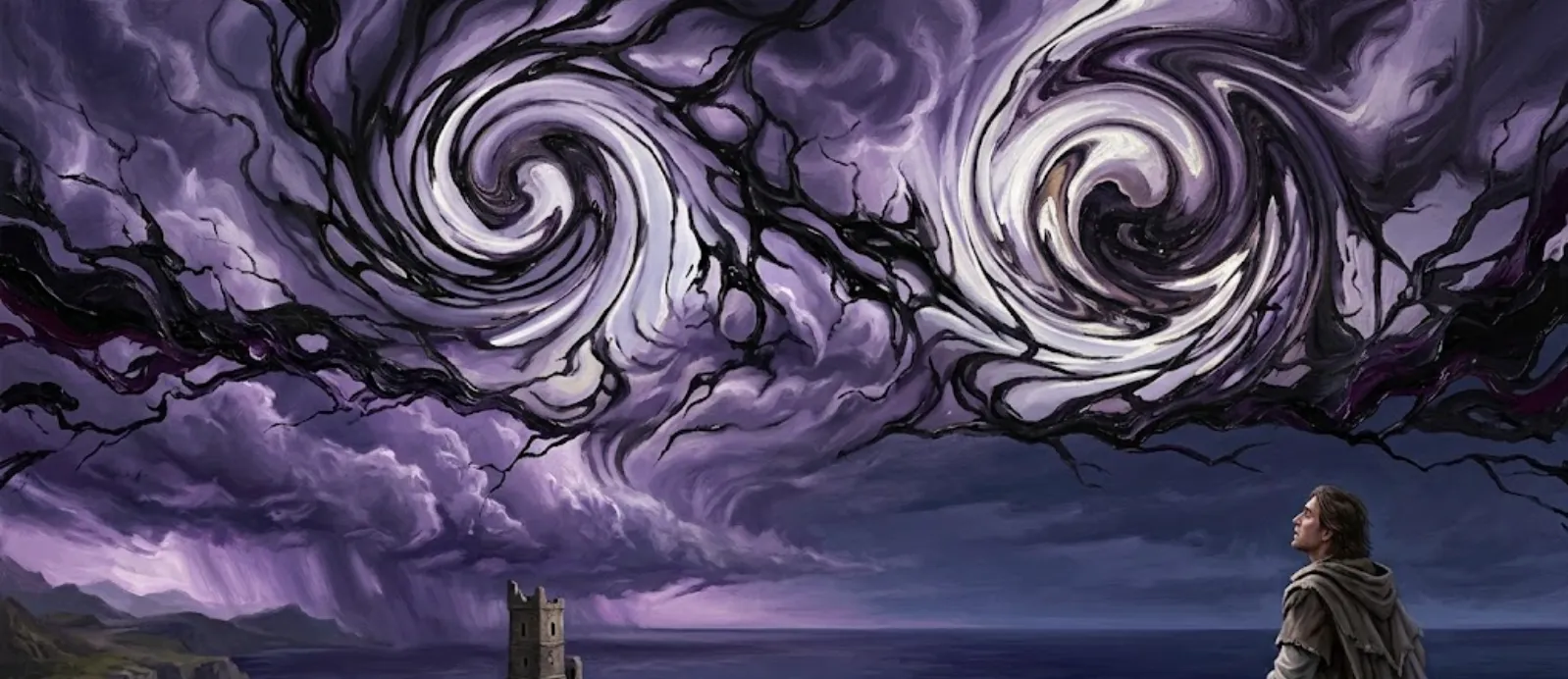
The Old Religion of Andarra is built on a single, simple premise: two gods, two forces, one cosmic war. El is the benevolent creator. Shammaeloth is the source of all evil. The Banes are his monsters. The Boundary holds them back. It is a clean story — the kind that spreads easily, that people reach for when they need the world to make sense.
James Islington spends three books dismantling it. By the end of the Licanius Trilogy, almost every foundational belief about El and Shammaeloth has been revealed as either wrong, weaponized, or both. The deception is not a twist engineered for shock — it is the engine the entire plot runs on. Understanding it requires following three separate threads: what the ordinary people of Andarra believe, what the immortal Venerate believe, and what is actually true. They are three different things.
The religion as it is taught — and who believes it
To the people of Andarra — and to most readers entering the trilogy — the theology is straightforward. El created the world and humanity. Shammaeloth opposes him. The Augurs served El. Aarkein Devaed served Shammaeloth. The Boundary exists to contain Shammaeloth’s Banes, who are locked in the north behind it. Faith in El is the counterweight to that darkness.
This is the institutional layer of the Old Religion. It is a story built for mass belief, and it functions exactly as intended: it explains the Boundary, it explains the Banes, and it gives the suffering caused by both a cosmic meaning. The Andarran populace does not interrogate it. Why would they? It is coherent. It has priests and texts and centuries of tradition behind it.
And critically — it is not entirely wrong. Islington is careful about this. The creation myth, the existence of Shammaeloth as a genuine entity, the idea that the Augurs had a real purpose — none of these are pure fabrications. The Old Religion contains enough truth to function. That is what makes the lie inside it so effective.
What the Venerate think they know
The Venerate are not ordinary believers. They are immortals — given their immortality long before they ever encountered either El or Shammaeloth, bound to the world by an ancient device called the Forge. They believe they possess the actual truth behind the Old Religion’s simplified public version.
According to Gassandrid, the creation story is real, but the Old Religion has the outcome of the primordial conflict wrong. The Venerate believe that it was not El who won. It was Shammaeloth — and his victory was not a military one. It was metaphysical. Shammaeloth trapped El within the bounds of time. In doing so, he created fate itself: a fixed, deterministic current that strips humanity of true free will. Every human life, in this framework, is a story already written. Choice is an illusion.
Their immortality, the Venerate were told, was El’s gift — a means of fighting back. Unbounded by time, they could bend fate’s path. They could break Shammaeloth’s prison of inevitability and restore genuine choice to the world. This is the purpose that drove them to commit atrocities across millennia. They did not see themselves as villains. They saw themselves as humanity’s last hope against a god who had quietly enslaved the future.
“Choice is meaningless if it cannot affect the outcome.” — Meldier, The Licanius Trilogy
Meldier’s argument captures the philosophical core of the Venerate’s position. They are not wrong that determinism, if real, is monstrous. Their error is in what they do with that belief, and in who they trusted to hand it to them.
The actual truth: Shammaeloth’s masquerade
The Venerate’s “real truth” is also a lie. A more sophisticated lie, told to more discerning recipients, but a lie structured the same way as the public religion: built on a foundation of genuine fact, with the critical detail reversed.
The entity the Venerate have served, communicated with, and worshipped as El — for millennia — is Shammaeloth himself.
He did not invent the concept of El. The Old Religion and its creation myth already existed before he co-opted it. This is what makes the deception so durable: Shammaeloth used a pre-existing truth as his costume. He found a belief system, stepped into it, and handed the Venerate a version of it that was just heretical enough to make them feel like insiders — like people who had seen past the simplistic public faith to something real. That feeling of being trusted with the actual truth is one of the most effective manipulation tools there is. The Venerate never doubted what they knew because they believed they had earned it.
His method, confirmed in the text, is to use fragments of truth to lend strength to his lies. The free will argument the Venerate were given is not pure fabrication. The questions it raises about fate and determinism are genuinely hard ones. Islington does not dismiss them. He simply shows what happens when a being with unlimited patience and inhuman cunning gets to frame those questions — and provide the answers.
“He is very, very good at using truth to lend strength to his lies.” — An Echo of Things to Come, Book 2
Shammaeloth did not approach the Venerate with an implausible story. He approached them with a philosophically serious one. The claim that fate imprisons free will is a genuine metaphysical argument. The claim that their immortality gave them power to fight it felt empirically true — they were immortal, they could do things ordinary humans could not, and they had watched history bend in ways that seemed to confirm their actions mattered.
What he concealed was his actual goal. Shammaeloth needed the Venerate to destroy Dareci — the vast, sprawling capital of the Darecian Empire, home to millions — to force the creation of the Jha’vett, a time-travel device. Creating the Jha’vett tore a rift to the Darklands, the lightless realm that is the source of kan. Shammaeloth’s true purpose was never to free humanity from fate. It was to widen that rift until he could use it to escape this world entirely — leaving the Darklands to flood in behind him and consume everything that remained.
The civilization Caeden leveled as Aarkein Devaed is what the present-day characters know as the Plains of Decay. The rubble of millions of people, left as a geographical scar on the world. The Venerate believed this was a necessary cost of a greater liberation. It was the price of a god’s exit strategy.
The unanswered question: does El exist?
Here is what the trilogy declines to resolve. Shammaeloth co-opted a pre-existing religion. He did not invent El. The question of whether El is a genuine entity — a true creator who exists somewhere beyond the reach of the story — is left deliberately open. This is not a gap in the narrative. It is a choice.
True believers within the text maintain their faith to the end. Raeleth and Nihim hold that El is real — a genuine creator inextricably tied to the world, one who allows humanity true free will precisely because he does not intervene to enforce outcomes. Their faith is not naive. They have seen the devastation of a broken world and the horrors done in the name of religion. They choose to believe in El anyway, not because the evidence demands it but because the alternative — a world with no El, only Shammaeloth — is a world they refuse to accept as complete.
A dying Caeden demands that El show himself, that he intervene, that he prove his existence by acting. He receives no response. No sign. He realizes there were no answers to be had here — and dies without one. — The Light of All That Falls, The Licanius Trilogy Book 3
Islington does not give the reader a resolution because he is not writing a story about whether God exists. He is writing a story about what people do when they believe they know — and what it costs when that certainty is weaponized against them. El’s existence or non-existence is beside the point of the trilogy’s actual argument. What matters is that the Venerate’s faith in a divine authority was the exact mechanism Shammaeloth needed to make them useful.
The ambiguity is the answer. It is the only answer Islington offers, and it is a more honest one than a definitive reveal would be.
The Forge, kan, and the mechanics of immortality
One of the most common points of confusion in the trilogy is the relationship between the Venerate’s immortality and their ability to draw kan. They appear connected — both are extraordinary abilities possessed by the same people. But they are entirely separate mechanisms with entirely separate origins.
An ancient, Builder-made device. Not a divine gift. Not tied to El or Shammaeloth.
Asar confirms that the Venerate were already immortal long before they ever encountered Shammaeloth. Their immortality predates the entire deception. It is not a supernatural reward — it is a mechanical process. The Forge is an artifact from the Builder civilization, and the Venerate are permanently bound to it. When a member of the Venerate dies, their connection to the Forge pulls them back from the Darklands and forces resurrection.
This means the core premise Shammaeloth gave the Venerate — that their immortality was El’s gift, a weapon forged specifically to fight fate — is a complete fabrication. He did not give them immortality. He found people who already had it, explained it to them as a divine mandate, and handed them a mission.
Power drawn from the Darklands. Taught to the Venerate by Shammaeloth himself.
Kan is the magical system of the Licanius Trilogy — a force drawn from the Darklands, the realm of absolute darkness and absence. The Venerate did not have this ability naturally. Shammaeloth introduced them to it and taught them how to use it.
This is what makes Caeden’s ultimate solution so structurally clean: the Venerate’s immortality and their kan-use are both connected — indirectly — to Shammaeloth’s plan. The rift to the Darklands is both the source of kan and the doorway Shammaeloth wants to widen. To close it, every person capable of drawing kan through it must die. Because the Forge resurrects the Venerate, ordinary death is not enough — Caeden’s sacrifice must be absolute and permanent, which is what Licanius provides.
What Shammaeloth actually wants
Most readers assume — because the structure of the story implies it — that Shammaeloth wants to enter the world. He is behind the Boundary. His Banes are trying to get through. The obvious reading is that he is a force trying to invade.
The actual goal is the opposite. Shammaeloth wants to leave. He is not imprisoned in the Darklands. He is trapped in this world, waiting in the northern wastes of Talan Gol, behind the Boundary. The Darklands is a separate realm — a place of absolute absence, lightless, joyless, devoid of hope — and it is the source from which kan flows. What Shammaeloth wants is to march his armies to Deilannis, reach the rift created by the Jha’vett, and tear it wide enough to escape this world entirely.
What he leaves behind when he goes: the Darklands, flooding in through the widened breach to consume everything. The world does not survive his departure. It is not a conquest. It is an exit that burns the building on the way out.
Understanding this reframes the Boundary, the Banes, and the entire military plot of the trilogy. Shammaeloth does not need to get through the Boundary to win. He needs to get to Deilannis. The Boundary is a delay, not a final defense. The Banes are not invaders — they are a means of clearing a path.
The ending, reread
With the theology clear, the final movements of the trilogy read differently. Every major character arc converges on the same thematic point: accepting consequences rather than erasing them. Raeleth frames it directly, reminding Caeden that “Your past does not define you — no matter the consequences.” The trilogy’s argument is not that fate is real or that free will is an illusion. It is that seeking to avoid the weight of your own actions is how evil propagates. The Venerate were given a purpose that was, at its core, a permission structure for atrocity. They did not ask who benefited from their willingness to commit it.
The most complete arc. Caeden spent centuries as Aarkein Devaed, committing acts of civilization-scale horror in service of a purpose he believed was just. When the deception unravels, he does not bargain with it. He does not seek a second chance or a loophole. Instead, he travels back in time, shape-shifts into Davian, and allows his past self to behead him with Licanius. To save his friend and seal the rift, he literally accepts his death at the hands of the monster he used to be. The distinction, by the end, is the point.
Davian was fated to die in the past, and he accepts this, willing to travel back to make his death meaningful. But Caeden denies him the sacrifice. Caeden forces Davian to stay in the present and takes his place. Davian is left to live in the broken world, forced to carry the weight of his friend’s sacrifice and do the hard work of actually rebuilding society.
Asha absorbs the combined power of the Lyth and the Shadows — an immense, dangerous burden — to remotely sustain the Boundary and hold Shammaeloth’s armies back while the rift is closed. She takes the cost. Wirr, meanwhile, commands Andarra’s doomed defense. Facing annihilation, he makes the agonizing choice to use the Oathstone — the mind-control authority he holds — stripping his soldiers of their fear and forcing them to hold the line. He accepts the moral stain of doing an awful thing because it is the only way to buy the world enough time.
The Licanius Trilogy is not, at its core, a story about gods. El may or may not exist. Shammaeloth is real, but he is not a supernatural force of evil — he is a patient, intelligent being who found the right pressure point in the right people and spent millennia squeezing it. The real subject of the trilogy is the machinery of ideological manipulation: how genuine philosophical questions get weaponized, how the feeling of possessing hidden truth makes people extraordinarily useful to whoever handed it to them, and what it actually costs to undo that damage. The god’s name on the deception changes. The mechanism does not.