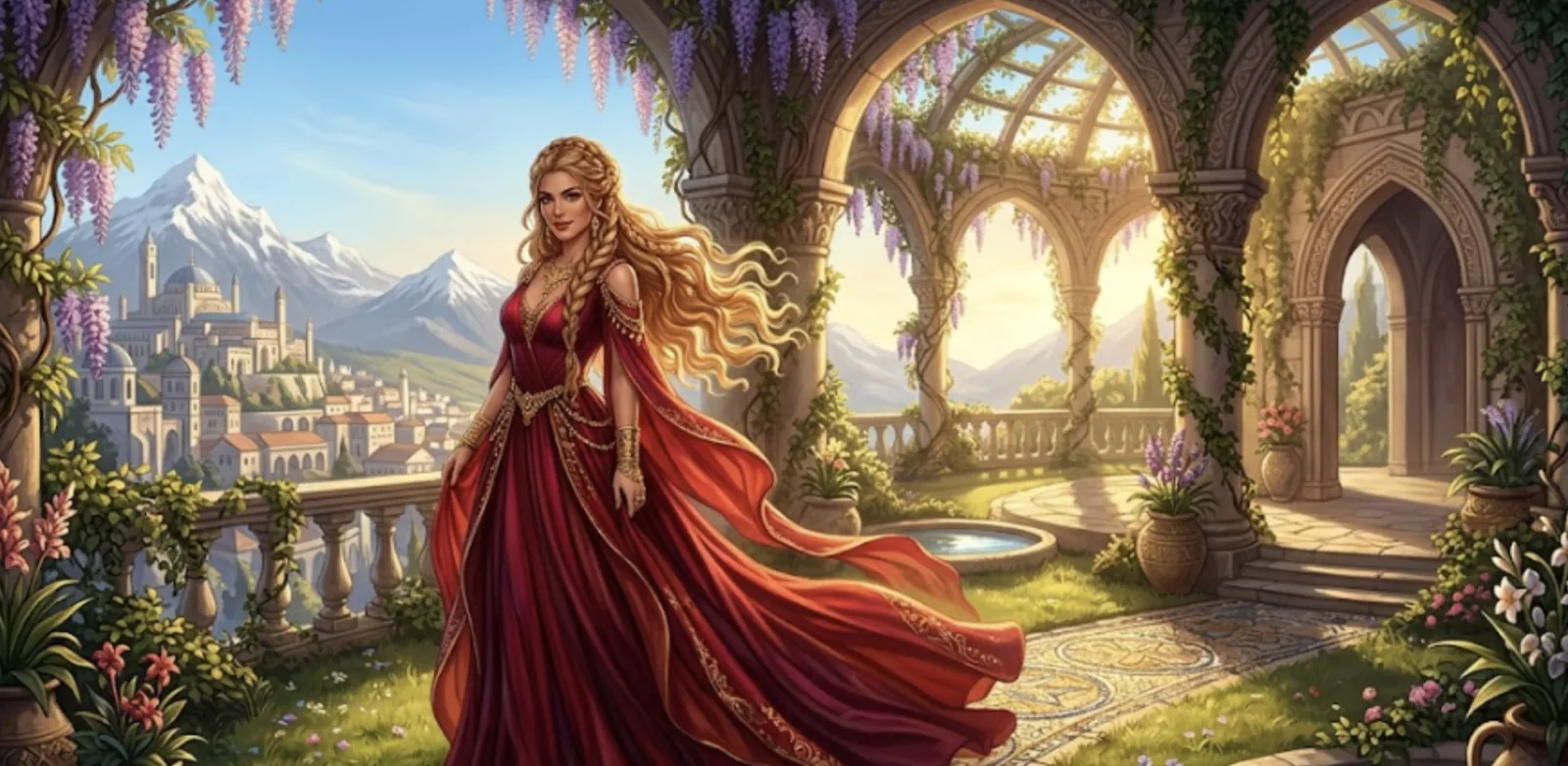

The name “Mórrígan” originates from Old Irish, generally translated as either “Phantom Queen” (from the root *mer- meaning “terror” or “death,” combined with the Old Irish rígan meaning “queen”) or “Great Queen” (from the Old Irish mór meaning “great”).
The Mórrígan is a battle goddess who incites psychological frenzy and heavily influences the tides of war.
She acts as a harbinger of doom or victory, foretelling the ultimate destinies and deaths of prominent warriors.
She personifies the harsh, protective spirit of the land itself, constantly testing leaders and conferring the right to rule.
She is a master of disguise, frequently shifting into a raven or crow to observe and orchestrate events unseen by those around her.
Every great deception requires a trustworthy face. Morrigan is beloved, warm, the emotional anchor of the Inner Circle — and the most consistent keeper of secrets in the series. These are not contradictions, but rather the Phantom Queen operating exactly as her name describes.
The phantom and the queen — what we see vs. what the text shows
Mórrígan’s mythological duality is perfectly mirrored in Maas’s characterization: the Phantom who moves unseen to shape outcomes, and the Queen who conceals a vast, sovereign power. Through a close reading of the text, it becomes clear that Morrigan’s warmth and fierce loyalty, while genuine, also function as an impenetrable cover. She acts as the emotional anchor of the Inner Circle, radiating joy and easy affection, but this vibrant persona deliberately masks an unparalleled capacity for compartmentalization. We see the Phantom dancing at Rita’s or laughing with her friends, distracting us from the Queen who holds profound secrets from those she claims to love most. Every outgoing gesture she makes is a calculated misdirection, proving that her greatest deception is hiding her true self in plain sight.
Warm, joyful, the emotional heart of the Inner Circle.
Underneath, she kept her sexuality secret from her closest friends for over five centuries, dating back to before the War.
Fiercely loyal to Rhysand and the Night Court above all else.
Underneath, she maintained a sprawling private estate called Athelwood that she seems to have never mentioned to the others. In A Court of Frost & Starlight, it functions as a quiet retreat for her to ride horses.
Hates Eris openly — makes no effort to conceal the depth of her contempt.
Underneath, her hatred functions as a story she tells consistently that forecloses further examination. The text confirms Eris claims she “knows the truth but has never revealed it” and implies he did not actually leave her to die, raising questions about her narrative.
Uses her power to winnow — presented as straightforward.
Underneath, her power includes truth-related abilities, as she claims “truth can break and mend and bind.” The full ceiling has never been shown.
Her powers — and the ceiling we haven’t seen
Morrigan’s winnowing is presented as a highly effective tactical tool, frequently utilized for rapid extraction, infiltration, and bypassing enemy wards. The text confirms she can easily transport passengers, as she frequently winnows Feyre, Cassian, and others across vast territories.
Morrigan’s magical gift is “truth,” which allows her to wield the ancient Veritas orb and speak words that listeners intrinsically recognize as undeniable reality. Because the exact parameters of her power are unconfirmed, we cannot say she is physically forced to rely on omissions to avoid telling an outright lie; rather, her omissions function as a masterclass in using her reputation for “truth” to deliberately conceal her deepest secrets.
Morrigan casually employs magic to manipulate her environment and construct physical barriers. During a winter snowball fight at the family cabin, she effortlessly erects an “invisible shield against the bitter wind” to protect herself and Feyre from the cold.
Beyond her devastating combat potential, Mor frequently utilizes casual, everyday magic to summon or seamlessly transfer physical items. The text depicts her instantly manifesting a decanter and glasses of liquor directly into her hands, and when Cassian accidentally spews wine on her dress during dinner, she merely waves a hand to transfer the wine spots from her own clothing onto his leathers.
Morrigan is capable of physically scanning her surroundings for hidden threats by casting out her magic like a radar. While riding at her Athelwood estate, she senses a presence and spears a “tendril of power” into the dense woods to sweep the area for hidden beasts or watchers.
Throughout the five books, Morrigan is stated to be the fail-safe Rhysand will unleash “when the armies fail and Cassian and Azriel are both dead,” yet she is primarily depicted fighting with standard Illyrian blades and Seraphim steel. However, the text confirms her raw power is cataclysmic; she states that when her magic first awoke at seventeen, its force was so immense that “even that gods-damned mountain trembled around us.” This complete absence of apocalyptic, battle-ending magic on the page is narratively conspicuous for a character explicitly named after a mythological war goddess who single-handedly dictated the outcomes of epic conflicts.
Eris — the wound that functions as a wall
The dynamic between Morrigan and Eris is the one area where her behavior becomes legibly strategic rather than purely emotional. For centuries, the established backstory has remained absolute: after Mor’s family nailed a note to her abdomen and dumped her at the Autumn Court border, Eris found her, refused to aid her, and cruelly left her for dead. Yet A Court of Silver Flames drastically complicates this account, with Eris repeatedly insisting he left her untouched to secretly grant her freedom, claiming she “knows the truth but has never revealed it.” We need not assert that Morrigan is lying; rather, her absolute certainty and consistently performed hatred function as a defensive wall. Because examining Eris’s true motives requires examining her own account, her blazing hostility forecloses any further interrogation. Maas deliberately leaves the question open, allowing Morrigan’s anger to protect a narrative she refuses to unpack.
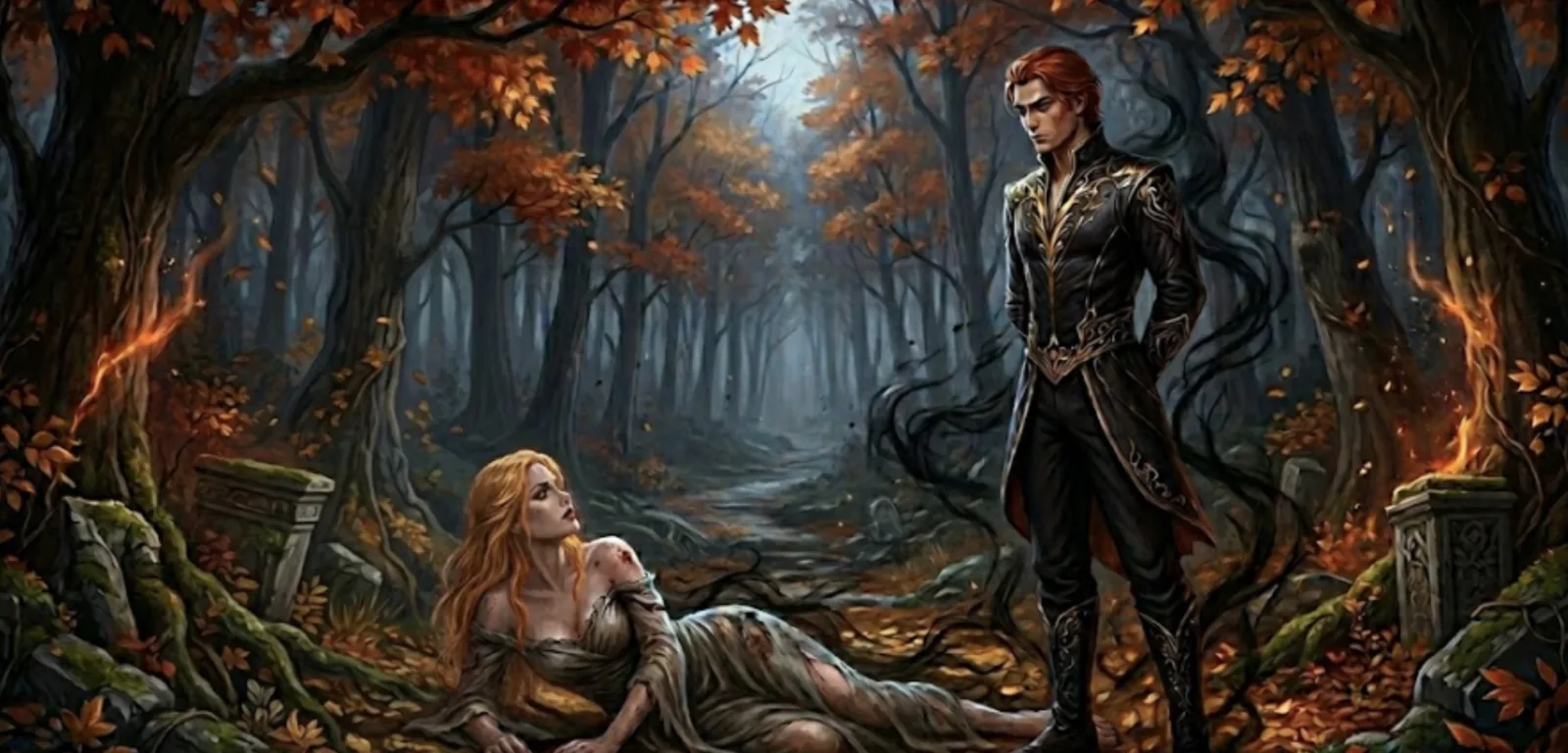
The Maasverse question — is she more than she appears across series?
The Celtic Mórrígan was a liminal deity, moving fluidly between battles, mythologies, and worlds without a fixed allegiance. As Sarah J. Maas explicitly builds a connected multiverse — the “Maasverse” — the analytical question becomes whether Morrigan holds significance across this larger cosmic canvas. By the end of the A Court of Thorns and Roses series, and confirmed through crossovers in Crescent City and Throne of Glass, we know these worlds share ancient Fae lineages, overlapping histories, and dimensional portals. However, there is currently no textually confirmed Maasverse material that specifically involves or references Morrigan crossing between these worlds or participating in the multiverse crossover events. Yet, if we examine the recurring symbol of the raven — the Mórrígan’s primary mythological avatar — we must ask if Maas has positioned her Phantom Queen to eventually step beyond the borders of Prythian.
Moved between battles and myths, aided different sides, allegiance to fate not to any king.
Acts as the fluid bridge and overseer between the Court of Dreams and the Court of Nightmares, and serves as the primary ambassador to human lands and foreign Fae courts like Vallahan.
In Celtic lore, the Mórrígan frequently shapeshifts into a raven or crow to fly over battlefields, prophesy doom, and observe events undetected.
Ravens appear as recurring symbols across the series: the King of Hybern’s elite assassins are literally named the “Ravens.” King Dorian Havilliard frequently shapeshifts into a raven to spy on Morath in Throne of Glass, and in Crescent City, “The Raven” is a notable ancient temple/club and Amelie Ravenscroft is an Alpha.

What she might do in Book 6 — four theory cards
The text repeatedly establishes Mor’s unmatched capacity for compartmentalization, seamlessly hiding her sexuality and her private estate for centuries. Because she is so adept at constructing impenetrable public personas, Book 6 — a looming crisis point for Prythian — is the most narratively sound moment for a hidden, personal agenda to surface. If her true allegiance belongs to something older or deeper than Rhysand’s court, the Phantom Queen’s ultimate misdirection is about to break.
A Court of Silver Flames explicitly establishes that Eris intends to overthrow his father, Beron, who has secretly allied with Briallyn. With Eris actively conspiring with the Night Court to seize the Autumn throne, Mor’s sealed narrative about her abandonment is perfectly positioned to fracture. If the truth complicates her centuries-long hatred, Mor herself may be the one who ultimately resolves the Autumn Court succession crisis — and not in the bloody way anyone expects.
The Celtic Mórrígan was a catalyst who started wars without fighting them, shaping outcomes through strategic truth-withholding and prophecy. If Mor’s tightly guarded secrets or her unexamined narrative regarding Eris actually instigate the central conflict Book 6 must resolve, she will not be a villain, but rather a mythological catalyst. By creating a war through omission and unseen maneuvering, she would be fulfilling the exact promise of her namesake: determining fate from the shadows.
The fandom frequently theorizes a connection between Mor and Queen Maeve from Throne of Glass, given Maeve’s dark power, manipulation of truth, and dark hounds. However, there is zero textual basis confirming Mor is connected to Maeve; Maeve is definitively established as a Valg queen.
While Sarah J. Maas is building a connected multiverse, she historically repeats character archetypes rather than literally repeating characters. It is highly unlikely Mor is a villain in disguise from another universe.
Her arc, book by book — re-read through the mythology
Through the mythological lens, Morrigan acts as an orchestrator who shapes the board for the coming war. She wields the Veritas orb before the human queens, using her gift of “truth” to project the image of Velaris and bend reality. She acts as the vibrant, trustworthy face of the Inner Circle, deliberately serving as a distraction that hides the Night Court’s deepest secret — and her own — in plain sight.
Just as the Mórrígan hovered over battlefields to dictate outcomes, Mor conspicuously stays away from unleashing her catastrophic, mountain-shaking magic on the front lines. Her most significant action is psychological rather than physical. She finally confesses her concealed sexuality to Feyre, proving that the Phantom Queen’s greatest power lies in compartmentalization. By controlling her own narrative, she determines the emotional fates of those around her.
In the aftermath of war, Mor retreats to her hidden estate of Athelwood, a sovereign domain she kept secret from the Inner Circle. Here, the Queen sheds the Phantom’s performative warmth, seeking solace with her horses and the untamed wilds. The text reveals her expertly compartmentalizing her dread over an impending diplomatic mission, choosing solitude to protect her own closely guarded inner world.
We have spent five books reading the warmth instead of the mythology, choosing to forget that Sarah J. Maas deliberately named her after a Phantom Queen. Book 6 is the inevitable precipice where that illusion must shatter, and her name finally becomes a prophecy. When the armies fail and her centuries of sealed narratives break open, we will at last witness the Queen who has been hiding behind the beloved face finally stepping into view.