
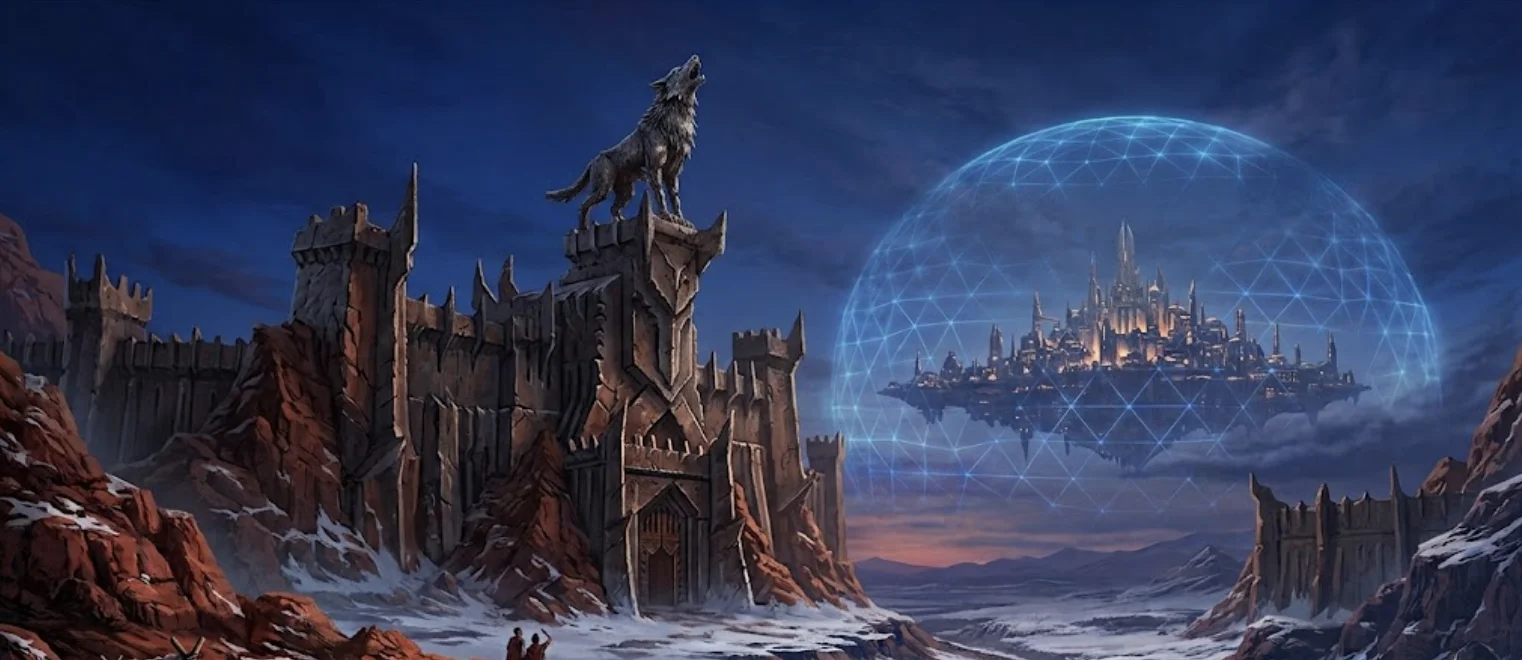
The Institute is not a school in any conventional sense. There are no teachers, no classrooms, no grades; instead, there is a remote terraformed valley, twelve medieval castles, and ten months of extreme hardship. While 1,200 students are initially drafted, they are forced to fight in one-on-one battles to the death on their very first night in a secret culling known as the Passage, leaving only 600 survivors to conquer each other by any means available. At the end of the year, the surviving students are divided into three distinct tiers. The elite victors become the Peerless Scarred — the Society’s future commanders and governors. The middle tier become regular Graduates who must still fight to earn their scars in the real world. And those who fail or remain enslaved are Shamed and sent to manage harsh, distant colonies like Pluto.
What happens inside the Institute is highly classified. This is everything you need to know.
What is the Institute?
The official purpose of the Institute is straightforward: to transform spoiled Gold teenagers into the Society’s next generation of leaders by subjecting them to extreme hardship. The Institute is designed to age its students “fifty years in ten months.” It strips away their pampered upbringings and teaches them, through direct experience, how their ancestors conquered Earth and built an interplanetary empire.
The actual purpose is a brutal form of forced Darwinism. The Society needs rulers who are ruthless enough to make impossible decisions under pressure, cunning enough to lead fractious armies, and psychologically resilient enough to carry the weight of murder. The Institute reveals whether those qualities are already present — and eliminates the students in whom they are not.
There are also multiple Institutes. Every year, across every major Gold population center, the same brutal process plays out simultaneously across the universe, with other Golds battling it out on Venus, Earth, Luna, and more locations. The Institute Darrow attends is on Mars, located in a remote terraformed valley in the southernmost part of the Valles Marineris — completely cut off from the outside world.
Admissions: tests and the Draft
Admission to the Institute is not guaranteed by lineage alone. Every Gold applicant must survive a grueling admissions process before they are considered.
The physical testing is extreme: applicants are subjected to oxygen deprivation, amplified gravity, exposure to intense freezing and boiling temperatures, and pain tolerance assessments. The intellectual component includes tests like the slangSmarts exam, which measures extrapolational thinking — the ability to reason intuitively from incomplete information. These tests are designed to be nearly impossible to prepare for. The Society is not looking for students who studied as much as it is looking for students who are capable of thinking differently.
Students who pass are entered into the Draft — a process held in a massive grid-room where powerful Drafters (Praetors, Imperators, Tribunes, Adjudicators, and Governors from across the Society) and twelve Proctors, each representing one of the Institute’s Houses, observe the candidates in their grid boxes and select their picks in order. Being chosen early in the Draft is a mark of perceived potential. The Houses are the basic units of social and military organization throughout the year. While not insurmountable, being chosen last (lowDraft) is a vote of low confidence that tends to limit mobility in subsequent war games.
A small number of exceptionally well-connected students bypass the Draft entirely. Known as Premiers, these are the sons and daughters of the most powerful Gold families, whose parents have pre-selected their House before the process begins. It is the Institute’s first lesson in how the Society actually works: the rules apply to everyone, except those with enough power to ignore them.
The Passage: the Institute’s best-kept secret
The Institute’s first act of psychological manipulation begins before the Passage even starts. Upon arriving, students are treated like royalty. A lavish feast is laid out, Pink masseurs attend to them, and they are sent to sleep in luxurious dormitories with silk sheets. It is only after they fall asleep with full stomachs, lulled into comfort, that masked attackers ambush the students in their beds, beat them, bag them, and load them into transports. After a disorienting flight through the night, they are dragged into isolated, subterranean stone rooms in pairs. A Proctor enters, tosses a single golden House ring onto the floor, and delivers a single instruction: only one student will leave the room alive.
The Passage serves two purposes. The first is to eliminate the weakest half of the student body before the war game begins, ensuring that every surviving student has already demonstrated a willingness to kill to survive. The second is to psychologically bind the survivors together. Every student who walks out of that room has committed murder. The shared guilt binds House members together through trauma in a way that no shared victory ever could.
The Passage is the best-kept secret in the Society. Students who survive it are forbidden from speaking of it. Parents who attended the Institute and went through it themselves say nothing to their children. What waits in that room on the first night is something every Gold knows will come, and no Gold will warn you about.
Every Gold who has earned the scar has killed someone to get there. That is not incidental to the Institute’s design. It is the design.
The twelve Houses
Students are divided into their twelve Houses during the Draft itself — before they ever set foot in the valley, and before the Passage begins. Darrow is drafted into House Mars, eats a grand dinner with his new Housemates at their designated table in a massive orientation hall where all 1,200 students dine together, and goes to sleep in the luxurious centralized orientation dormitories before the culling even starts. They are ambushed in their beds, flown to the valley, and only the survivors of the Passage ever set foot inside the actual House castles.
This sequencing is not incidental. It is the cruelest part of the design. The students are not fighting strangers in the Passage — they are fighting their own newly appointed brothers and sisters. As Darrow realizes after killing Julian: one hundred students per House, and the bottom fifty are only there to be killed by the top fifty. The shared trauma binds the House together specifically because they were forced to murder people they had just broken bread with.
Each House begins the year with practically nothing: black and gold fatigues bearing their House symbol on the high collars and sleeves, basic medieval-style weapons, their House standard, and the castle they must defend. There are no modern comforts and no guaranteed safety net. Students must forage, hunt, and raid for food, relying on the rare deployment of medBots to save them from fatal wounds, and earning bounties of horses, weapons, or matches only by impressing their Proctors through exceptional feats. They live, for ten months, as their Gold ancestors did when they first conquered an unwilling humanity — with steel, cunning, and whatever they can take from the people around them.
The Standard
The Standard is both the symbol and the central vulnerability of each House. It is a physical object: a one-foot length of iron, elaborately worked, mounted atop a five-foot oak pole. For House Mars, the iron piece depicts a howling wolf standing atop a coiled serpent, which itself rests upon the star-tipped pyramid of the Society. Each House has its own equivalent design.
The Standard must be carried and defended at all times. If an enemy soldier presses the Standard to another student’s forehead, a slave sigil — a wolf for House Mars — immediately appears on that student’s skin, marking them as the property of the conquering House. Slaves are bound to obey their new masters unconditionally — disobedience results in permanent Shaming, the worst designation the Institute can assign. The Standard is therefore not merely a symbol. It is a weapon, a trophy, and the axis around which the entire war game revolves.
The Primus and bars of merit
Every House has a single undisputed leader: the Primus. The title is not appointed by the Proctor — it is earned. In the House dining hall, each student’s name floats above their assigned chair in golden letters, with holographic bars of merit glowing beside it. These bars are not physical objects but a visible running score of exceptional deeds: strategic victories, captures, and acts of leadership that the House recognizes.
Toward the far end of the long dining room sits a stone plinth with a golden hand embedded in it — five fingers representing the five bars of merit required to claim the title of Primus. As a student earns merit, their name floats upward toward the golden hand. The first student to earn all five bars fills the hand and becomes Primus. There can only be one at a time. The Primus commands the House absolutely. It is the Institute’s internal hierarchy made visible — and in a room full of Golds who have been told their whole lives they are born to rule, the competition for those five bars is vicious.
The war game: rules, tactics, and how to win
The war games are meant to be a “case study in gaining and ruling an empire.” The objective is conquest — to subjugate the other eleven Houses to make one unified tribe. A House wins not by killing everyone else, but by capturing enemy standards to claim other students as slaves. Pure slaughter is neither the goal nor the strategy; as Proctor Fitchner explains, “Any fool can stick a blade into another’s belly.” Instead, the management of armies, the administration of justice, and the ability to secure provisions such as food and armor are what actually determine the outcome. Darrow ultimately breaks this paradigm by freeing his captives and treating them as equal soldiers, earning their voluntary loyalty to build an unstoppable army.
Outright murder using modern weapons is explicitly forbidden. Intentional executions, such as hangings, are also prohibited. General “ruthlessness” and accidental deaths in combat are accepted as unavoidable, but the Institute is not designed to depopulate itself. To ensure the game produces survivors rather than corpses, the Proctors deploy medBots from Olympus to swiftly cauterize wounds and treat severe trauma.
Houses can and do form alliances. Two or more Houses may agree to cooperate against a common enemy, share resources, or avoid conflict while targeting others. These alliances are inherently unstable — at some point, allies become rivals — but they are a legitimate and widely used tactic to shift the balance of power.
The game concludes when one House has unified the valley under its control. While the academic year provides a strict ten-month boundary, the Institute’s ultimate goal is to produce a single victor — a Primus who has demonstrated the absolute capacity to organize, command, and conquer.
Olympus and the Proctors
Floating nearly a mile above the valley in the bluish sky is Olympus — an artificial mountain topped with a fairy-tale castle that serves as the home and observation deck of the twelve Proctors. From Olympus, the Proctors observe the game, dispatch medBots, and issue bounties: rewards such as horses, weapons, and matches granted to students for capturing standards or performing exceptional feats. Olympus is the Institute’s version of the gods watching from on high — and much like the Roman gods the Houses are named after, the Proctors are entirely capable of petty interference.
At Darrow’s Institute, the Proctors — most notably Apollo and Jupiter, acting as guard dogs — have been secretly threatened and bribed by ArchGovernor Nero au Augustus to ensure his son, Adrius (the Jackal), wins the game. They intervene illicitly throughout the year, protecting favored students and sabotaging threats. One of their most devastating acts of manipulation involves a classified holo-recording that revealed Darrow killed Julian in the Passage; the Proctors provided this recording to the Jackal, who then had his subordinate Lilath deliver it to Cassius. This deliberate leak triggered the brutal blood feud and duel that left Darrow gutted in the freezing mud.
Darrow at the Institute
Darrow enters the Institute as the tenth overall pick in the Draft, selected for House Mars by Proctor Fitchner — a choice that draws skepticism from the other Drafters. His first night at the Institute ends with him beating Cassius’s twin brother, Julian, to death in the Passage. Darrow actually knows who Julian is — the two had met on the shuttle ride to the Institute and conversed amicably before the culling began. Cassius does not know what Darrow did, and for months, this secret sits between them like a loaded weapon.
House Mars fractures almost immediately into competing tribes. A brutal giant named Titus seizes control of a faction, subjugating captured students and committing horrific acts of violence. Darrow eventually discovers that Titus is himself a carved Red — another infiltrator consumed by blind vengeance because Gold elites raped a girl he loved back in the mines. Recognizing that Titus’s approach is not a revolution but a repetition of everything the Society already does, Darrow sentences him to death. Crucially, Darrow does not execute Titus himself — he allows Cassius to take his place in a duel, watching as Cassius kills Titus to “avenge” Julian’s death, despite knowing that Titus is innocent of that particular injustice. Darrow later realizes this was a failure of true justice: merely giving free license to vengeance.
A broken brotherhood
Darrow and Cassius forge one of the Institute’s most formidable partnerships. They fight together, win together, and build something that looks like genuine friendship across the first months of the game. Then the corrupt Proctors leak a classified holo-recording to the Jackal, who has his subordinate Lilath deliver it to Cassius, revealing that Darrow killed Julian in the Passage. Cassius guts Darrow in a bloody duel and leaves him to die in the freezing mud.
Mustang finds him. She pulls him out of the mud and nurses him back to health in a cave through the winter, repayment for a kindness that Darrow showed her earlier in the games when he spared her as his House was conquering hers. She also teaches him something the Institute’s designers did not intend: that voluntary loyalty is more powerful than coerced slavery. When Darrow is healthy enough to return to the game, he does not enslave the students he captures. He frees them, treats them as equal soldiers, and earns their allegiance rather than commanding it. His army becomes fanatical not because they have to follow him, but because they choose to.
The Howlers
The most unconventional unit Darrow creates at the Institute is the six students no one else wanted, led by Sevro au Barca — a small, feral lowDraft pick who no one takes seriously.
This pack becomes known as the Howlers, and forms after Sevro kills a wolf pack leader in the wilderness and begins wearing its pelt. He trains his squad to survive in the wild on nothing, moving through the valley unseen. They begin making unearthly howling sounds in the night — sounds that carry through the dark and unnerve every other House. The original six are Sevro, Thistle, Screwface, Clown, Pebble, and Weed.
Over time, they all begin to wear black wolfcloaks, and operate as a completely independent unit, ghosting through the valley, striking without warning, and disappearing before anyone can respond. Loyal to Darrow over any other House, the Howlers become one of the most important military units in the first book, and are also the people who make Darrow’s final, decisive move in the war games possible.
Storming Olympus
When Darrow realizes that the Proctors are actively cheating to ensure the Jackal wins, he does something no student in the history of the Institute has ever done: he declares war on the Proctors themselves.
Using Proctor Apollo’s gravBoots, and a pair stolen from Proctor Fitchner given to Sevro, they fly up through a blinding snowstorm toward Olympus nearly a mile above the valley floor. The Howlers hang from their arms and legs using belt harnesses, carried up through the storm by Darrow and Sevro. They take Olympus by surprise.
By taking the Proctors hostage, Darrow achieves two things simultaneously. He ends their illicit cheating, and he strips them of their advanced technology — recoilArmor, gravBoots, ghostCloaks, razors, and pulseWeapons — and distributes it to his army. Student forces armed with medieval weapons and horses suddenly find themselves facing an enemy equipped with god-tier military hardware. The game does not last long after that.
The Jackal
Adrius au Augustus — the Jackal — is the student the entire system is rigged to protect. He is the ArchGovernor’s son, and the Proctors have been secretly threatened and bribed to ensure he wins the game. All of this help does not make him any less savage, and his tactics define him more clearly than anything else. Early in the year, he deliberately collapses a tunnel on his own House Pluto classmates, trapping them underground without food until they resort to cannibalism. He does this to forge them into something feral and absolutely loyal through shared horror.
Rather than being cornered by Darrow, the Jackal attempts to infiltrate Darrow’s camp disguised as a captive named Lucian. When Darrow sees through the ruse, he pins the Jackal’s hand to a table with a dagger and tells him he can leave if he cuts it off — expecting the Gold to refuse, because he assumes Aureates are only ever willing to sacrifice others, never themselves. Instead, the Jackal calmly begins sawing through his own wrist, declaring that a hand is a peasant’s tool, stopping only when Pax provides an ionBlade to finish the job cleanly. However, a corrupt Proctor suddenly tosses a sonic detonator through the window to aid the Jackal’s escape. Grabbing the detonator, the Jackal uses the very ionBlade Pax just gave him to stab the giant in the throat. As the device detonates, Pax shields Darrow with his own body, taking ten more stab wounds before the Jackal flees into the night, leaving his severed hand behind. It is the introduction to a character who will spend the next two books demonstrating that the Institute’s most dangerous graduate is not the one who fights the hardest, but the one who feels nothing, even when the cost is themselves.
Graduation
At the end of the year, every student who attended the Institute is placed into one of three permanent designations that follow a Gold for the rest of their life.
What Darrow’s victory actually means
Darrow wins the Institute in glorious fashion. He does not simply conquer the other Houses — he storms Olympus, captures the Proctors, arms his army with their technology, and ends the game on his own terms. His victory is unprecedented enough that it makes him one of the most coveted graduates in recent memory, with Drafters clamoring to recruit him after graduation.
The man who ultimately claims his contract is Nero au Augustus — the ArchGovernor of Mars, the man who ordered Eo hanged, and Mustang and the Jackal’s father. Augustus secures Darrow’s loyalty, binding him as a Lancer for House Augustus. Darrow kneels before him, swearing an oath to forsake his father, abandon his name, and become Augustus’s sword.
But his oath is a lie. The apprenticeship is the next phase of Darrow’s plan. To destroy the Society from the inside, Darrow needs to command fleets and lead armies — and the only way to get there is through the man who built the world he intends to tear down.